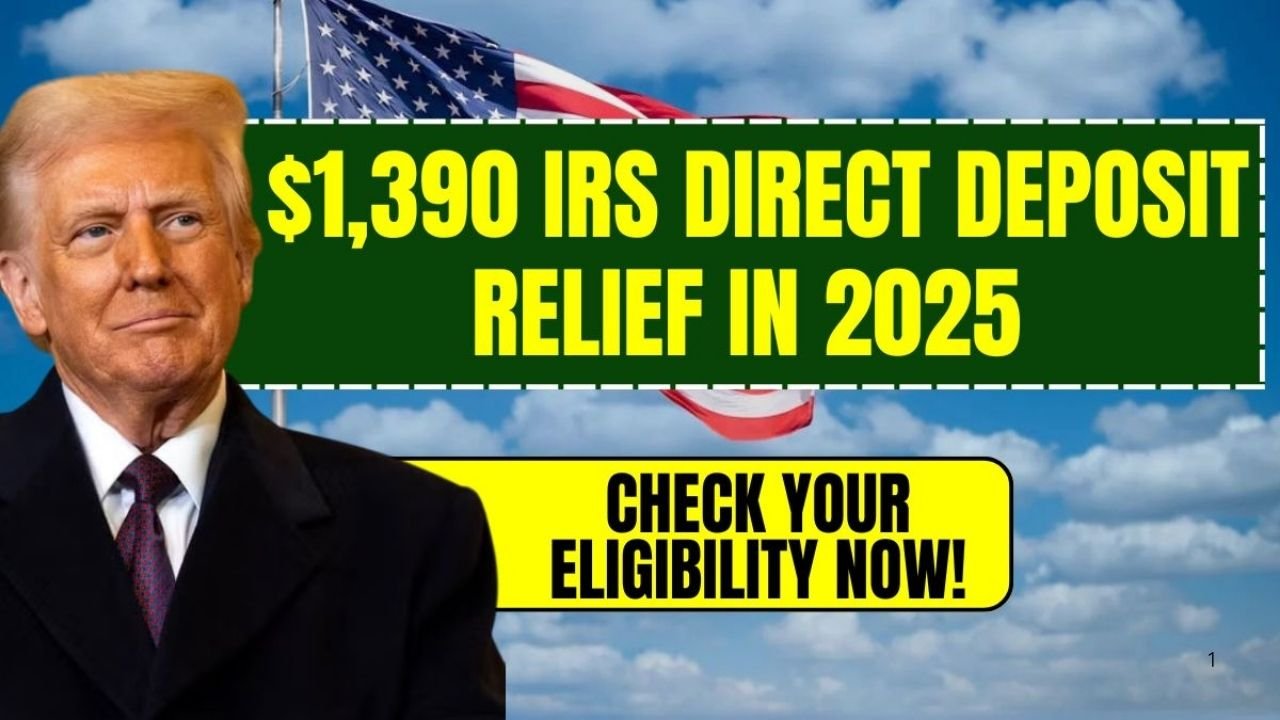
In late December 2025, online discussions reignited around a supposed $1,390 IRS direct deposit relief payment. Social media posts, forwarded messages, and blog articles claimed that millions of Americans would automatically receive this amount before the end of the year. Given the continued pressure from inflation, interest rates, healthcare costs, and seasonal expenses, the story spread quickly and felt believable to many households.
However, when examined closely, the claim does not match any verified action by the Internal Revenue Service or the U.S. federal government. Here is a clear, factual breakdown of what is true, what is not, and what taxpayers should realistically expect.
What the Online Claims Are Saying

The circulating claims describe a one-time $1,390 payment allegedly issued by the IRS through direct deposit, using bank details already on file. According to these posts, individuals without direct deposit information would receive a paper check instead. Many versions also suggest that no application is required and that payments would be distributed nationally by year’s end.
To enhance credibility, these posts often include official-sounding language, payment timelines, and vague eligibility descriptions. Despite this presentation, no supporting documentation, IRS notice, or federal announcement exists to validate the claim.
The IRS’s Official Position as of December 2025
As of December 2025, the IRS has made no announcement regarding a new nationwide relief payment, rebate, or stimulus-style program. The agency’s public focus remains on routine responsibilities such as processing tax refunds, resolving amended returns, and preparing systems for the upcoming 2026 tax filing season.

There is no official guidance, press release, or policy update that references a $1,390 payment. The absence of confirmation from the IRS is a strong indicator that the claim is not legitimate.
Why the Rumor Feels So Convincing
The credibility of this rumor largely stems from collective memory. During 2020 and 2021, the federal government authorized multiple rounds of pandemic-era stimulus payments. Those payments were automatic, widely distributed, and required little to no action from recipients.
The current rumor borrows heavily from that framework, using familiar language such as “automatic payment,” “direct deposit,” and “no application needed.” While the structure sounds familiar, the circumstances are very different. No emergency legislation has been passed in 2025, and there is no economic relief bill authorizing a new payment of this kind.
Congressional Approval Is Mandatory for IRS Payments

It is important to understand that the IRS does not have independent authority to issue large-scale payments. Any nationwide relief or stimulus program must first be approved by Congress, funded through the federal budget, and signed into law.
As of mid-December 2025, there has been no congressional vote, no budget allocation, and no legal framework supporting a $1,390 payment. Without this approval process, the IRS cannot legally distribute funds under any relief label.
Why Some Americans Are Still Receiving IRS Deposits
Although the $1,390 rumor is false, some taxpayers are legitimately receiving IRS deposits in December. These payments are part of normal tax administration and are unrelated to any new relief initiative.
Common reasons for IRS deposits include delayed tax refunds from earlier filings, adjustments from amended returns, corrections following updated income information, or payments issued after audit or review resolutions. Because these deposits can arrive unexpectedly, they are sometimes misinterpreted as a new government program.
State-Level Payments Add to the Confusion
Another major source of misunderstanding comes from state-issued assistance programs. Several states continue to provide targeted financial support, such as energy rebates, renter credits, or property tax relief. These payments are issued by state revenue departments, not the IRS.
When state payments arrive via direct deposit, recipients may assume they are federal funds. Over time, this overlap between state and federal systems has fueled ongoing confusion and strengthened false national payment rumors.
Social Security and Federal Benefits Remain Unchanged
Federal benefit programs such as Social Security retirement benefits, Supplemental Security Income, and Social Security Disability Insurance continue to follow their regular monthly schedules. These programs are managed by the Social Security Administration, not the IRS.
There has been no announcement of a December bonus, emergency increase, or one-time extra payment tied to these benefits in 2025. Any claims linking Social Security payments to a $1,390 IRS deposit are inaccurate.
Payment Rumors and the Rise of Scams
False payment claims often lead to an increase in scam activity. Fraudsters may impersonate government agencies and attempt to collect sensitive personal or financial information.
Common warning signs include requests for bank account details to “release” funds, messages claiming immediate payment confirmation, or demands for Social Security numbers or processing fees. The IRS has repeatedly stated that it does not initiate contact through unsolicited emails, text messages, or social media platforms.
What Taxpayers Should Rely On
Legitimate federal payments are always announced publicly, supported by legislation, and explained clearly before distribution begins. There is currently no evidence of a $1,390 IRS direct deposit relief payment in 2025.
The most reliable approach is to trust official government communications, verify information through established sources, and remain cautious of viral claims that lack confirmation. Staying informed and avoiding unverified payment promises is the best way to protect both finances and personal information.
Conclusion
Despite widespread online discussion, the $1,390 IRS direct deposit relief payment is not real. No law has been passed, no funding approved, and no announcement made by the IRS or Congress to support such a program. While some Americans are receiving legitimate tax-related deposits or state-level payments, these are being mistaken for a new federal initiative.
In a digital environment where financial rumors spread rapidly, clarity matters. Relying on verified information and official announcements remains the smartest strategy for navigating claims about government payments in 2025.